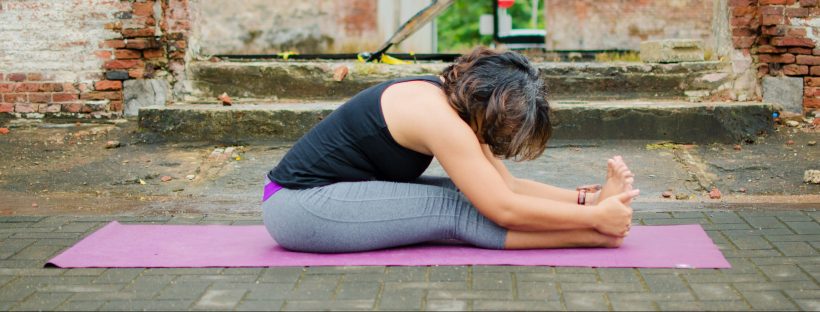
“In ashtanga yoga there are two terms that are common”, said the yoga teacher. I was carefully paying attention to what she was saying, cause ashtanga was not my regular practice. The first term was sukha, which means “being comfortable”. The other was dukha, meaning “pain, suffering”. She explained that in ashtanga yoga you need to keep both sukha and dukha in mind, cause you can not be too comfortable in a posture but you also must not hurt yourself doing so. I decided to make that my intention for this practice.
The pose
As I noticed, the asana paschimottanasana (seated forward fold) comes very effortlessly to me, the past few times. I can actually keep my back straight and at the same time bind my hands. So I sat there, breathing in and out, wandering thoughts on things happening at home, at work. It was not until the teacher pushed me to go a little further, that I realized that I was being too comfortable in the pose that this pose as I was doing it at the moment didn’t work for me anymore. “Inhale lengthen, exhale bend a little deeper”. As she helped me to go deeper into this pose, I came back to my practice, the present. And how I noticed that my nose was lightly touching my knee. And ow, how I actually felt those hamstrings stretch. The day after, I still felt the tension, so I know it had worked for me.
Life after the practice
So what happens after the practice? For me, the yoga practice never stops. I mean, of course the practice stops (literally), but the mindset, every thought that comes to mind while practicing, that continues. Even in daily life we have to keep the sukha and dukha close to mind. We cannot sleep in, when we have to go to work, therefore we have to practice sukha. As for dukha, I need to look into this some more.
Fun fact, not related to this blog at all:
Sukha dukha kind of means “Look for the money” in Surinamese. Ironic… Like looking for money while suffering… just to be comfortable?
 Path To Self Discovery